Skip to product information
1 of 1

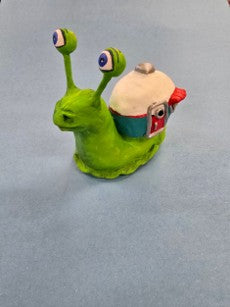
Original Sculpey® Snail Shell

Original Sculpey® Snail Shell

Designed by Susan Stegall
Read More
This project was designed as a classroom project but the questions work for an artist working at home as well. • The point of this project is to make the shell anything else except a shell!! • What do snails represent in our culture? • What kinds of other homes are in our community or around the world? • Do you want to make a funny statement or do something more serious?
Read Less
ADDITIONAL SUPPLIES
  • Aluminum foil
  • Wire
  • Hot Glue Gun with Glue
  • Matte Acrylic Paints
  • Paint brush
View full details
Project Instructions

Step 1

How to Bake Original Sculpey®

Before curing your Original Sculpey® oven-bake clay project, set yourself up for success with these professional claying tips:

  • Cover and protect your workspace: Unbaked clay may damage furniture and finished surfaces, so make sure your work area is covered.
    We recommend working on the Sculpey Tools™ Oven-Safe Work Mat, ceramic tile, wax paper, metal baking sheet, or aluminum foil.
  • Condition the clay for durability: Skipping the conditioning
    process can result in a weakened finished product and increase the risk of
    cracks, imperfections or breaking over time.
  • Establish a consistent clay thickness: Cracking can occur during
    baking if the project has areas of clay that are too thick. We recommend
    “bulking out” denser projects with an aluminum foil core and adding a
    supportive wire armature inside like a skeletal structure, especially for
    figures with limbs.
  • Test your oven temperature: Many ovens are not calibrated accurately and are hotter than the dial's temperature setting. Use an oven thermometer to determine the correct temperature and adjust as needed. Condition and shape a 1/4 inch, or 6 mm, disc of Original Sculpey® clay, then bake the test piece according to package instructions. If the clay has darkened areas after baking, your oven is too hot. Lower the oven temperature by 10 degrees and test again.

Now comes the fun part — it's time to bake/cure the clay!

  • Preheat the oven: Confirm temperature accuracy with an oven thermometer and preheat the oven or toaster oven to 275 °F (130 °C).
  • Place the clay on an oven-safe surface: Transfer the project onto an oven-safe baking surface. For best results, use a piece of glass, ceramic tile or metal baking sheet with our highly recommended silicone Sculpey® Oven-Safe Work Mat. Because paper cannot catch fire at this temperature, you can safely place card stock or parchment paper between your project and the baking surface.
  • Bake the clay: Slide your project on its oven-safe baking surface into the center rack of the preheated oven. Bake at 275 °F (130 °C) for 15 minutes per 1/4 inch, or 6
    mm, thickness. For example, a 1/2-inch thick piece of clay should bake for 30 minutes.

Step 2

Make an aluminum foil armature.

You will need approximately 20 inches of foil for the body and shell.

Make the Body and shell separately. Don’t compress the foil for the body and ‘shell’ too much. It is ok to compress the head and neck a little more for strength. It is ok if it isn’t perfectly smooth, the crinkles help the clay attach.


Step 3

Wire support for the eyeballs.

Use an electric drill to make a hole for the wire. You can mark the holes with permanent marker.

Feed one length of wire through the hole to make both eyes. Bend them upward. You can trim the wire with wire cutters to even them out.

Hot glue the wire into place.


Step 4

Covering the foil armatures of the shell and the body.

Each student will get 5 ounces of clay.

Condition the clay and apply small amounts of clay at a time to the foil and smooth it. Apply enough clay that it covers the foil and has a little thickness.

Also make sure you cover ¾ of the wires but leave room for 2 small balls of clay that come in the next step.


Step 5

Make the eyeballs.

Roll 2 small balls of clay and add to the wires.

Smooth the joint between the stem and the eye so that you can’t see a seam.


Step 6

Face details for the snail.

You have complete creative freedom here! I added a mouth and nostrils, but you can add
teeth, a tongue, a nose whatever details you want your snail to have!

Step 7

Sculpt the shell. I made mine into a camper.


Step 8

Attaching the shell to the body.
Make a small ball of clay super warm. It makes it sticky and will ‘glue’ the pieces together.

Press the ‘shell’ down on the clay ball while it is still warm. Some will squish out around the bottom of the shell. Smooth the clay down using your fingers.


Step 9

Bake at 275 F for 30 minutes. Allow to cool completely and then paint as
desired.