
Skip to product information
1 of 1

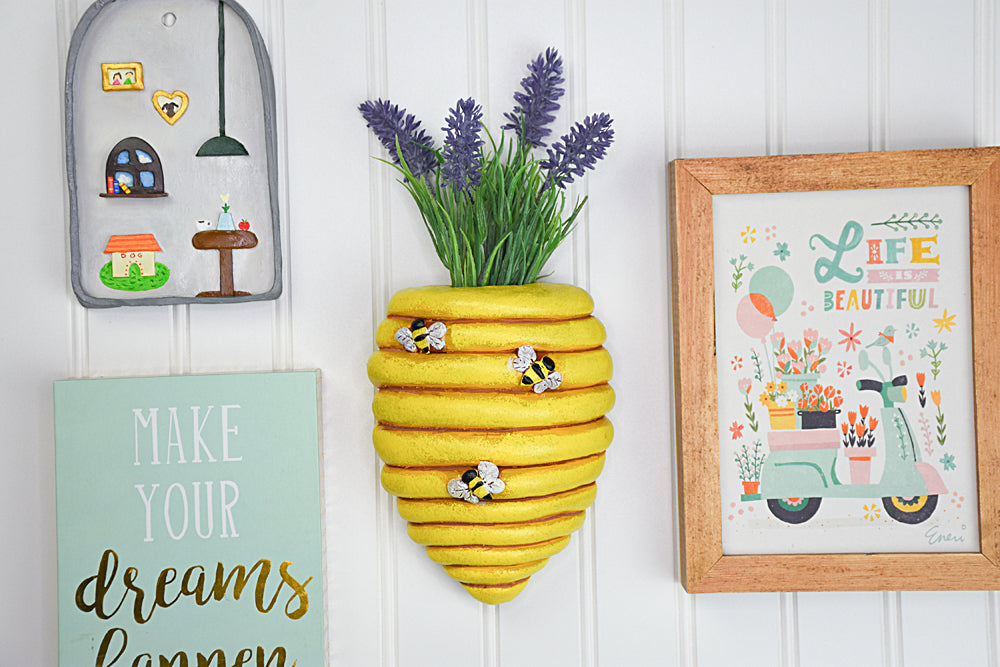
Original Sculpey® Terra Cotta Beehive Wall Planter

Original Sculpey® Terra Cotta Beehive Wall Planter

Designed by Amy Koranek
Read More
Delight your favorite indoor gardener with this adorable beehive wall planter. Even your “non-gardeners” will love this, dressed with artificial plants. COMPLETION TIME: 3 Hours to make, bake, (bakes once for 15 minutes, and a second time for 1 hour) and paint. Drying time needed for paint.
Read Less
ADDITIONAL SUPPLIES
  • Empty toilet tissue cardboard tube,
  • Packing tape,
  • Wood skewer,
  • Large paper clip,
  • Damp rag,
  • Glossy acrylic paint in Yellow and also School Bus Yellow,
  • Glossy acrylic paint White,
  • Glossy acrylic paint Black,
  • Paint brush - fine,
  • Sponge
  • NOTE: You will need two blocks of the Terra Cotta clay for this project
View full details
Project Instructions

Step 1

Getting Started:

Please make sure your work area is covered and you are not working on an unprotected surface. We recommend working on the Sculpey® Oven Safe Work Mat, wax paper, metal baking sheet, or disposable foil. Uncured clay may damage unprotected furniture or finished surfaces. Be sure to cover your crafting area appropriately.

Start with clean hands, unwrap and knead clay until soft and smooth, or condition by running clay though a Pasta Machine. We recommend using a designated machine for clay purposes only. When working with multiple colors, clean hands with soap and water or baby wipes (we have found that baby wipes work best) before switching colors. Shape clay, pressing pieces firmly together.  Wash hands
after use.

Baking (also called Curing):

Begin by preheating oven to 275 °F (130 °C). After you are done creating; for best results bake clay on an oven-proof surface such as metal, aluminum foil, an index card or the Sculpey® Oven Safe Work Mat at 275°F (130 °C) for 15 minutes per ¼" (6
mm) of thickness according to package directions. Oven safe glass or ceramic
surfaces are also acceptable for baking; however please note that the baking
times may take longer as the glass or ceramic surfaces take longer to heat
up. For best baking results, use an oven thermometer. DO NOT USE MICROWAVE
OVEN. DO NOT EXCEED THE ABOVE TEMPERATURE OR RECOMMENDED BAKING TIME.


Step 2

To prepare the wall hanging planter, we need to provide a hollow space for the plant. Prepare a cardboard tube (from toilet tissue or paper towels) that is about 4” long. Wrap the tube in packing tape and let the packing tape wrap a little around the open ends. Packing tape will help make the tube removable after the clay is baked. We need to remove the tube from the clay so that the plant can be watered once housed in the clay planter.

Step 3

Sheet enough Original Sculpey® Terra Cotta (OSTC) with the Acrylic Clay Roller to a sheet at least 3/16” thick and large enough to just wrap the tube.

Step 4

Trim the clay and butt the seam together. Do not overlap the seam.

Step 5

Trim the clay flush around the open ends of the tube with a Clay Blade.

Step 6

Roll the tube on the work surface to smooth the outside and to smooth the seam.

Step 7

Smooth the seam completely with fingertips as needed. Smooth the edges of the clay around the open ends of the tube with fingertips. Don’t allow clay to go inside the tube. Bake the tube following the instructions for Original Sculpey®. Allow to cool completely.

Step 8

Carefully remove the tube from the inside of the clay.

Step 9

Take your time in removing the tube. Preserve the clay tube, even if you have to destroy the inner cardboard and tape tube.

Step 10

Here’s a look at the clay tube once the cardboard and tape are removed.

Step 11

Sculpt a cone from OSTC that will fit on the bottom of the tube. Please note, if you want your planter to have a weep hole in the bottom, you should poke a hole through this cone before proceeding. You will also want to make sure that as you sculpt the bee hive that this hole remains open. A wood skewer is a good tool for poking the hole - not shown in photos.

Step 12

Sculpt two large, tapered pieces to go along the sides of the tube and the cone.

Step 13

Add the tapered pieces along each side. Smooth the seams with fingertips. Trim excess clay as needed. Smooth everything as well as possible. We are bulking out the shape of the hive and none of this will ultimately show in the finished piece. Keeping these add on pieces smooth will help build the beehive.

Step 14

Sandwich a large paper clip on the back between the tube and some fresh clay. This will serve as a hanger for the finished project.

Step 15

Now we will start making the finished shape of the beehive. Roll ropes of OSTC about 1/2” thick. We will place thicker ropes in the middle and thinner ropes toward the bottom. Start in the middle with a thick rope. Drape it across the middle of the beehive and trim it on both sides to fit the shape of the hive.

Step 16

Add similar sized ropes above and below. Trim each rope where it meets the sides in back. Make sure all ropes are making good connection with the base clay and with each other using hand pressure without smashing them.

Step 17

At the top of the hive, smooth the last rope with your fingertips to blend into the original clay tube. Make sure the paper clip still emerges from the back.

Step 18

Here’s a look at my beehive with all the ropes in place.
Smaller ropes were added toward the bottom. Transfer the hive to your baking sheet.

Step 19

Time to sculpt some little bees to decorate the front of the hive. For each bee make a round head, a tapered teardrop body, and four flat teardrops for wings - two larger and two smaller.

Step 20

Add the bees to the front of the hive and add textures with the Needle Tool.

Step 21

This beehive is quite large and will require a longer baking period based on baking at 275F for 15 minutes per quarter inch of thickness. In order to bake the large piece well and evenly, dampen an old cloth and wring out as much water as you can. Then gently place the cloth over the hive as shown. This will help the hive to bake more evenly by slowing the outside temperature to better match the inside temperature. I baked my hive like this for one hour.

Step 22

Allow to cool completely before painting.

Step 23

Base paint the entire hive in School Bus Yellow or a warm yellow. I left the bees unpainted as well as the cracks between the hive ropes. I like the Terra Cotta to show through a bit so I did not allow paint to go into the cracks. I like to use glossy paints on top of the flat Terra Cotta. This is only a preference because I like the contrast between the flat clay and the glossy paint.

Step 24

When the School Bus Yellow was dry, I sponged Yellow over the top. I like the texture of the sponge applied paint. I allowed the base yellow to show through the top sponge coat.

Step 25

Here’s my hive with the two coats of yellow paint.

Step 26

Go ahead and give the bee bodies a base coat of yellow as well.

Step 27

Add white and black paint details to the bees. Allow paint to dry completely before using your planter.